iPhone won't charge to 100% – what it means and when it's a serious problem | AppleGuru
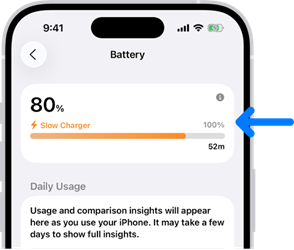
Have you noticed that your iPhone stops at 80%, 90% or, say, 92% and refuses to charge any further?
Whether it happens only now and then or every day, it isn't a normal state of affairs – and it may point to an emerging problem that will gradually get worse.
At AppleGuru we deal with cases like this every day. Below you'll find the most common causes, and also when you need to bring the device in for diagnostics.
1. Battery protection (Optimised Battery Charging) – common and harmless
Let's start with the best-case scenario.
Your iPhone sometimes stops charging at around 80% in order to extend the battery's lifespan. It mainly does this:
- overnight
- when the phone is warm
- when it's learning your charging habits
How can you tell?
The screen shows the message:
“Charging limited…”
§ If this happens only occasionally and the phone has no other problems, it's a normal feature.
Tip: Not sure whether it's a feature or a fault?
Book a quick diagnostic check, free of charge.
2. Your iPhone won't stop heating up – and charging stops
If the phone is too hot, charging automatically slows down or stops completely for safety reasons.
This mainly applies to:
- playing games while charging
- using GPS in the car
- charging in a case
- charging in direct sunlight
Why is this a problem?
Persistently high temperatures destroy the battery, make it age faster and can damage other parts of the phone.
§ If your iPhone heats up even during ordinary charging → diagnostics are needed.
Want to be sure? Book an appointment online.
3. A faulty or worn-out battery – a common reason why charging stops at 80–90%
Over the years, a battery loses its ability to hold its capacity. Your iPhone may look as though it's charging, but the capacity stagnates.
Typical symptoms:
- the charge level jumps up and down
- the iPhone runs down faster than it used to
- charging stops at the same percentage every day
- the iPhone switches off at a lower charge level
§ Solution: battery replacement (a quick, safe repair that restores stability)
The most common repair: iPhone battery replacement – book it here.
4. A problem in the power circuit (PMIC) – a hidden but common fault
If charging stops at random percentages (80% one time, 65% the next, perhaps 94% another time), the problem may be on the logic board itself.
Symptoms of a faulty power circuit:
- the iPhone charges only some of the time
- sometimes it doesn't charge at all
- the charge level jumps back and forth
- the phone heats up even during undemanding tasks
§ Solution: logic board repair (microsoldering)
Book free diagnostics and we'll find the exact fault.
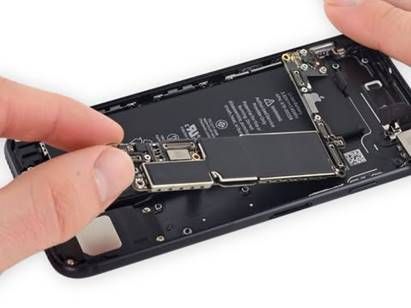
5. Your iPhone does show 100%, but it runs down unusually fast
Here the problem is no longer the charging, but the fact that the phone isn't showing the correct percentage.
The cause is often:
- a faulty battery
- an error in the capacity measurement
- a problem with the charging chip
§ Charges to 100% but drops quickly? → the battery and the power circuit need diagnostics
Call us and find out whether the problem is in the battery or in the power circuitry
When do you need to come to AppleGuru?
- the iPhone stops at the same percentage and won't charge any further
- charging stops at a normal temperature
- the phone heats up while charging
- it charges only some of the time
- the charge level jumps around (e.g. 80 → 83 → 78%)
- the phone sometimes doesn't charge to 100% and at other times does
- the iPhone has an older battery and its battery life is poor
In most cases we can find the problem within a few minutes

How we work at AppleGuru
- Diagnostics – a test of the battery, port, cable and power circuit
- Precise identification of the problem
- A proposed solution and a clear price up front
- A quick repair – battery or port replacement, or board repair
- We test charging all the way to 100%
- A warranty on every repair
Want your charging problem sorted out quickly? Book free diagnostics
iPhone won't charge to 100%? Drop in or give us a call
Don't put up with it any longer than you have to — the fault usually gets worse.